
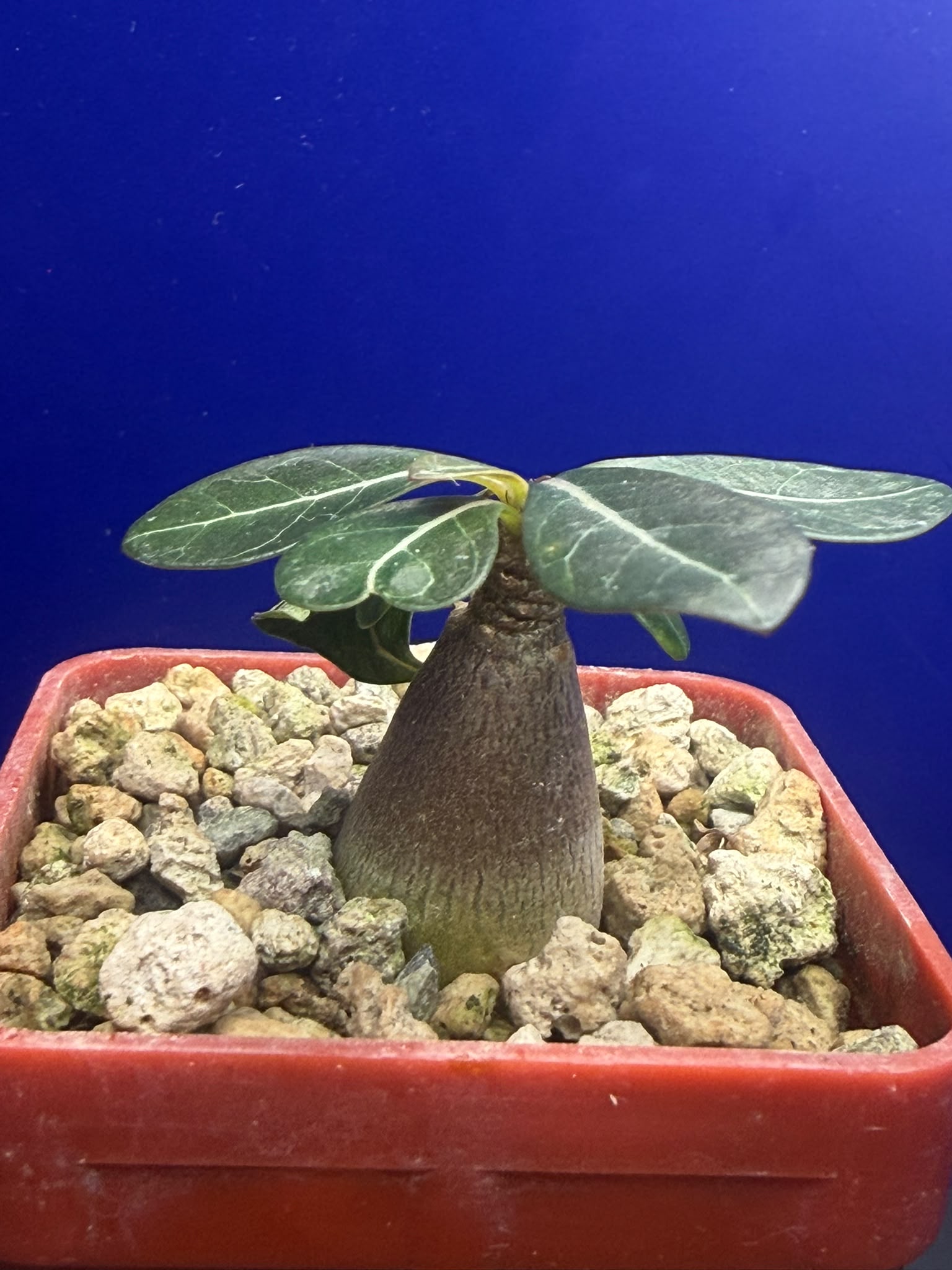
An island giant
in a small pot.
I found this young Socotran adenium at Festa del Cactus in Bologna in 2026. Its thickening base hints at the bottle-trunked plants that shape Socotra’s rocky slopes.
This plant came home with me from Festa del Cactus in Bologna in 2026. What caught my eye was the contrast already taking shape: a broad, swollen base beneath a small crown of leaves, each marked by pale veins. The great old bottle trees on Socotra are a distant scale for comparison; this one is still at the beginning of its life.
I don’t know its grower, seed source or earlier conditions, so I’m keeping those details open. The passport records the known part of its journey—the event and year it joined my collection—without turning the species’ island home into a claim about this individual’s origin.
The name has a small taxonomic wrinkle. Friedrich Vierhapper published Adenium socotranum in 1904. A Vienna herbarium record links the name to a specimen collected by Oskar Simony on Socotra on 12 January 1899, during an Austrian expedition. The epithet simply points back to the island.
Today, Kew’s Plants of the World Online treats A. socotranum as a synonym of A. obesum. The separate name remains widely used for the distinctive Socotran plants in horticulture and specialist literature. I’m retaining the familiar name on this record while making Kew’s treatment clear.
There is also a documented conservation-era cultivation story. John Lavranos collected a plant on Socotra in 1967; decades later he returned with botanist Bruno Mies, and they collected seed in 1997. The Huntington’s International Succulent Introductions later distributed seedlings from that collection. That record shows how a plant’s origin can travel with it when it is carefully documented—but it is not evidence that this specimen belongs to that seed line.