A rib becomes
a plate.
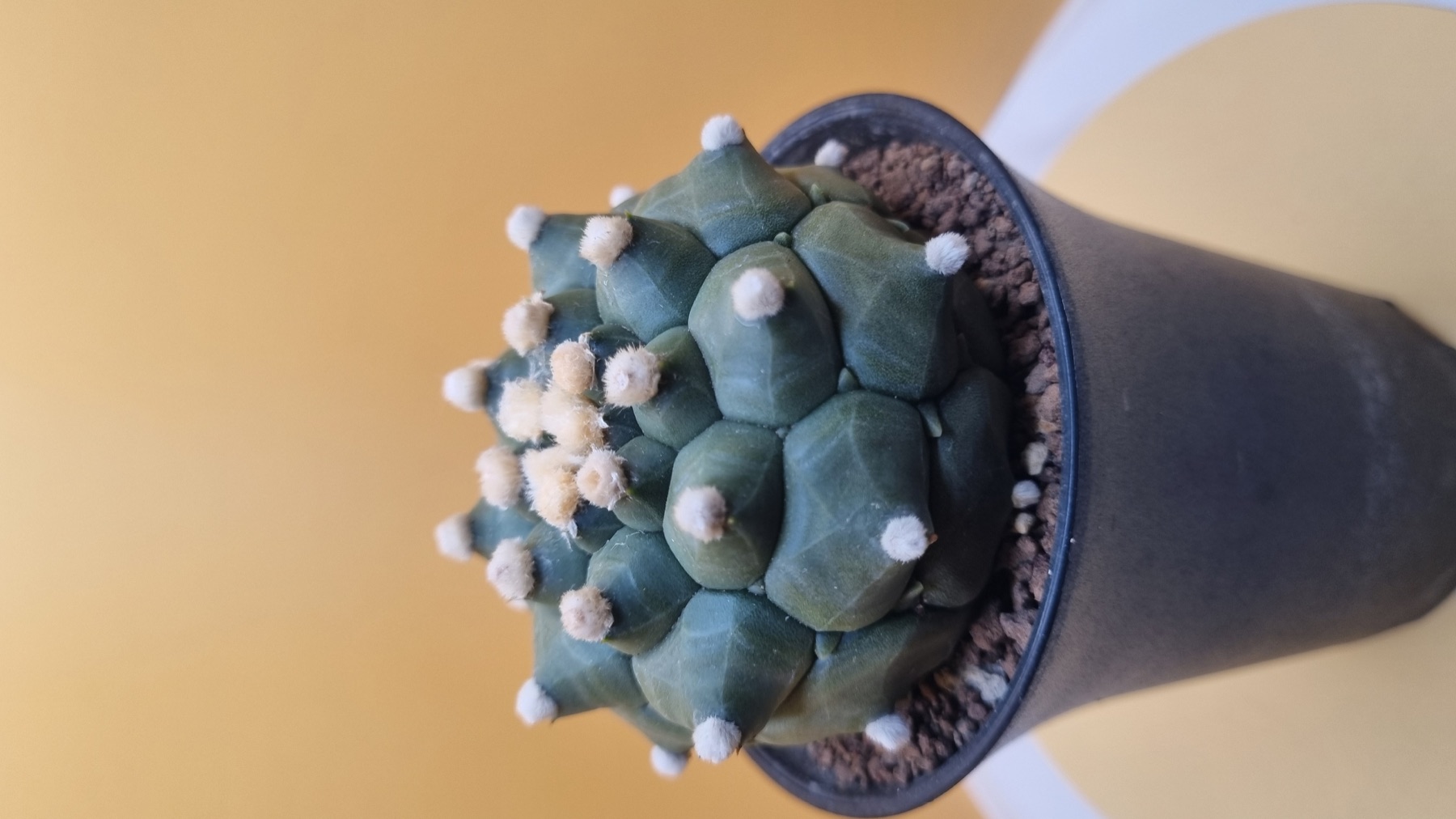
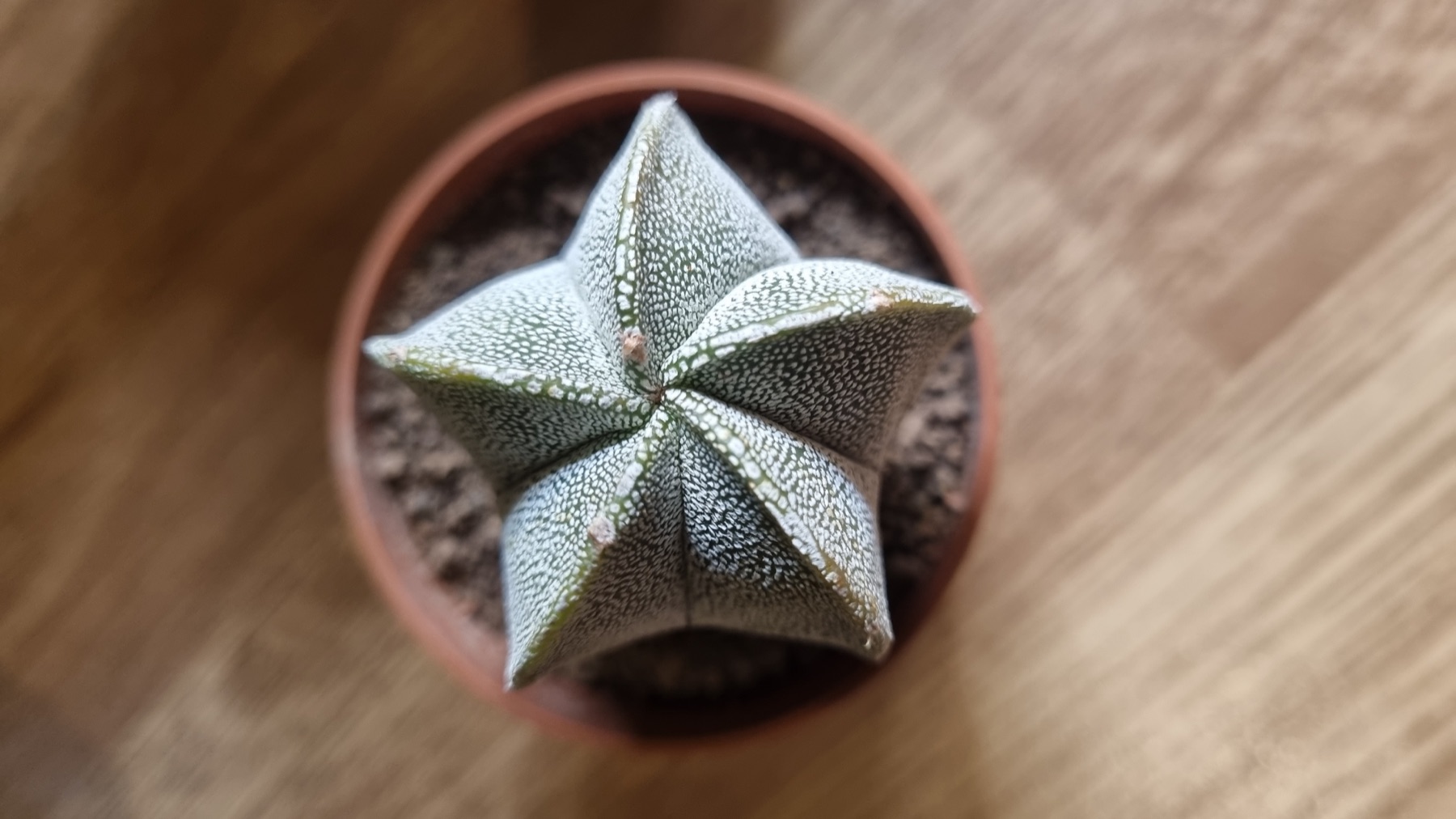
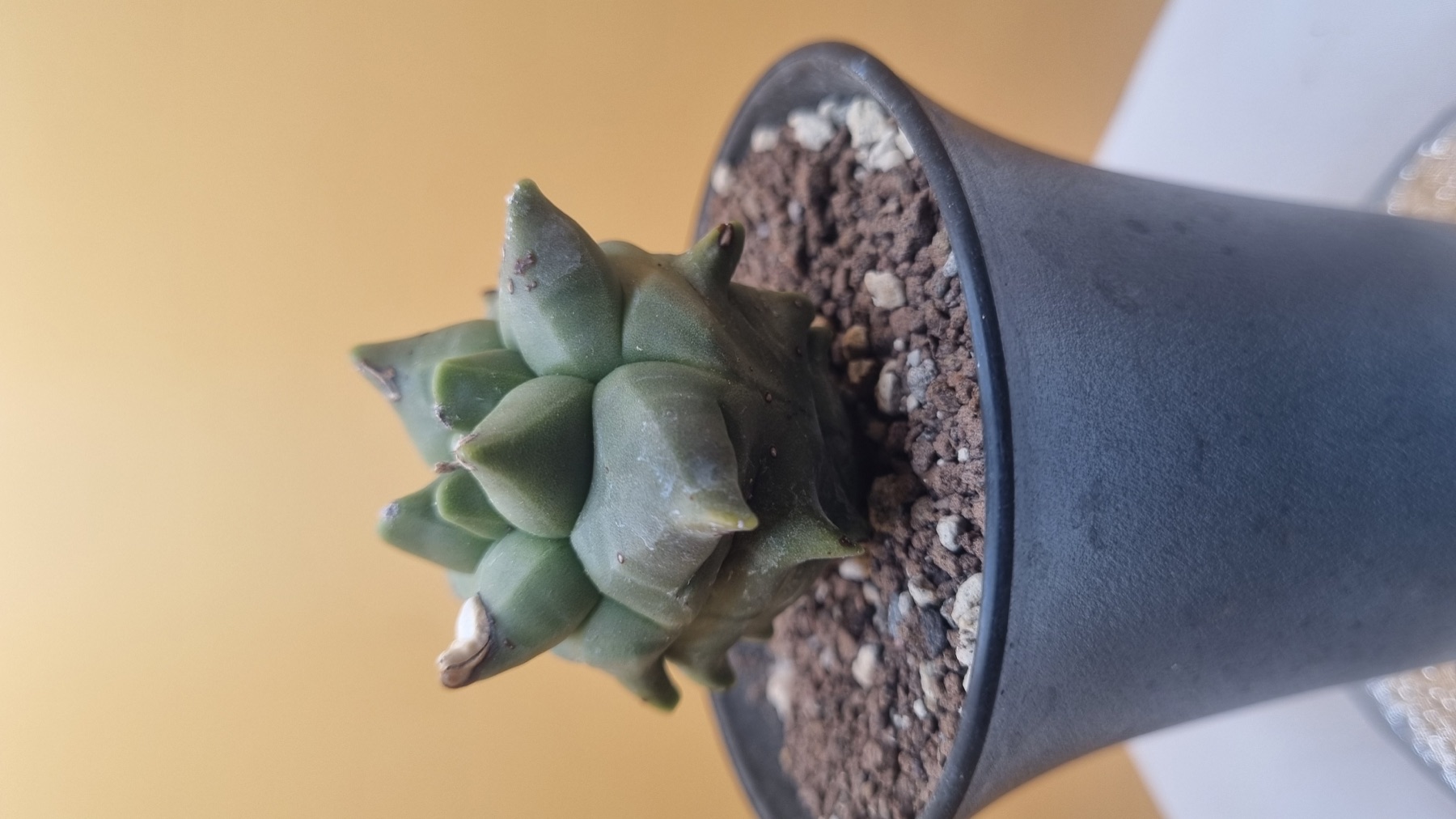
I bought this plant from La Casa del Cactus at Roma in Cactus in spring 2026. What caught my eye was the way its ribs break into raised, shell-like facets.
The tag reads Astrophytum myriostigma ‘Kikko’. Kikko is a cultivated form, not a wild species. The Japanese word 亀甲 means “tortoise shell”—a good description of the angular plates that interrupt the ribs. In this plant, the pattern is clear from the top and much more sculptural from the side. I want to see how the relief develops as it grows.
How far back can I trace the name? To 2005—not to the form’s origin. LLIFLE dates its Kikko entry 14 November 2005. A bibliography published in Debreceni Pozsgástár in 2006 records that the Russian magazine KAKTYCЫ, issue 4 of 2005, featured “Astrophytum myriostigma cv. Kikko Hekiran” on its cover. In 2010, Dieter Helm’s Biologie der Kakteen illustrated Kikko as a myriostigma whose continuous ribs break into distinct tubercles. These references show the named form in circulation by 2005; they cannot tell us how much earlier it appeared, who selected it, or where in Japan. I have not found a reliable record of those first steps.
The Cactus-Bakka post is useful for what it shows about growth. On 8 July 2015, the grower estimated the photographed seedling was about four years old and noted that its shell-like relief was only gradually appearing. Roman Pavlica’s 2019 account and developmental photographs describe the same wait: young plants can resemble ordinary myriostigma until the rib-edge notches become pronounced. With Kikko, the label can come years before the defining shape.
The wild species has a separate history. Astrophytum myriostigma was described by Charles Lemaire in 1839. In a study of 53 plants at Sierra El Sarnoso, Durango, researchers recorded depressed, cup-shaped and conical bodies in one population, with slope and aspect associated with the differences. That natural variation is striking, but it is not Kikko: the raised, shell-like relief belongs to the cultivated form. My plant came from a nursery in Rome; its passport does not claim wild provenance.
Research trail · 12 sources
- Kew · Plants of the World Online — accepted species name, native range and habitat.
- International Plant Names Index — nomenclatural record for A. myriostigma.
- LLIFLE · Kikko entry — cites 14 November 2005; useful dated evidence, not proof of the form’s origin.
- Debreceni Pozsgástár 2006/4 — bibliography noting the Kikko Hekiran cover of Russian magazine KAKTYCЫ 4/2005 (p. 56 of the PDF).
- Dieter Helm · Biologie der Kakteen (2010) — illustrated discussion of ribs and tubercles.
- Cactus Explorer bibliography — bibliographic record for Tony Sato’s Japanese-language Astrophytum Handbook 2 (1993), on the myriostigma family.
- Pavlica & Sumihiro Seki · Japanese Hybrid Astrophytum (2013) — specialist photographic record of Japanese Astrophytum lines.
- CACT.CZ · 2014 book announcement — publication date and scope for Pavlica and Seki’s work.
- Cactus-Bakka · 8 July 2015 — Japanese grower’s dated Kikko seedling observation.
- Cactus & Succulent Review (2015) — contemporary illustrated reference to Kikko nudum and Japanese Astrophytum lines.
- Roman Pavlica · 2019 developmental account — photographs and observations on when Kikko features become visible.
- Romero-Méndez et al. (2013) — peer-reviewed study of body-shape variation in wild plants at Sierra El Sarnoso.